


This post may contain affiliate links.
I can still remember, like it was yesterday, the first time I had a solo performance – and I mean completely solo. It was just me, a keyboard, and a microphone on that stage, getting ready to do a small set of songs in a genre that wasn’t my main focus at the time, and I was shaking.
And I’ll call it like it was – it wasn’t great. I messed up a couple times (which led to some momentary freezes), and my voice was shaky at best (breath support goes out the window when you’re nervous!). I did get through it with some lessons learned, and lived to see hundreds of more performances just like it!
Those pre-show (or during show) jitters are an experience common to every single musician you have ever seen share their craft with others – stage fright is a universal experience among performers! It can rear its ugly head for a myriad of different reasons, but the fact remains that overcoming stage fright is something that every musician and singer has to learn at some point in their journey.
It can feel like a lot, but don’t worry! I’m going to break down what stage fright is, reasons we experience it, and some helpful tips for overcoming stage fright right here in this post. With the right mindset, preparation, and strategies, you can learn to calm performance nerves and even turn that nervous energy into a better performance.
Understanding Stage Fright
The first step to overcoming stage fright is understanding it. So…

What is stage fright?
Stage fright is, at its very base, your body’s natural stress response responding to the pressure of a performance. Our bodies respond to stress with a flood of hormones and adrenaline, an elevated pulse, and quickened (more shallow) breathing designed to aid us in fighting or fleeing from a threat. As in all other areas of life, our stress response can rear its head in inappropriate situations – like before a performance.
Why do I get stage fright?
As mentioned above, the things we feel when experiencing stage fright are a part of the body’s fight or flight system. Even though we aren’t in any actual, physical danger, there are a number of things that can still trigger fight or flight before a performance:
- Fear of judgment
- Fear of failure
- Perfectionism
- Desire for Control
- Lack of Preparation
- Social Anxiety
- Past experiences
- Desire to impress
- High self-expectations
- … and more!
What is stage fright?
Stage fright is, at its very base, your body’s natural stress response responding to the pressure of a performance. Our bodies respond to stress with a flood of hormones and adrenaline, an elevated pulse, and quickened (more shallow) breathing designed to aid us in fighting or fleeing from a threat. As in all other areas of life, our stress response can rear its head in inappropriate situations – like before a performance.
Why do I get stage fright?
As mentioned above, the things we feel when experiencing stage fright are a part of the body’s fight or flight system. Even though we aren’t in any actual, physical danger, there are a number of things that can still trigger fight or flight before a performance:
- Fear of judgment
- Fear of failure
- Perfectionism
- Desire for Control
- Lack of Preparation
- Social Anxiety
- Past experiences
- Desire to impress
- High self-expectations
- … and more!
The perceived threat of all these things can cause elicit a stress response in our bodies, resulting in stage fright!
You’re not alone: Famous artists who have talked about having stage fright
I get stage fright and gremlins in my head saying: ‘You’re going to forget your lines’.
I have had a very difficult time with stage fright; it undermines your well-being and peace of mind, and it can also threaten your livelihood.
There are only two types of speakers in the world: The nervous and the liars.
I suffer from terrible stage fright. True. You can’t tell though, can you? Unbelievable, the panic. I nearly die of fear before I go on stage. Something wicked. I can’t eat a thing the day before a gig. It’d make me vomit.
I have big, big stage fright.
A little bit of stage fright, then I’m ready.
Overcoming Stage Fright: Reframing Your Mindset
Nervousness and Excitement
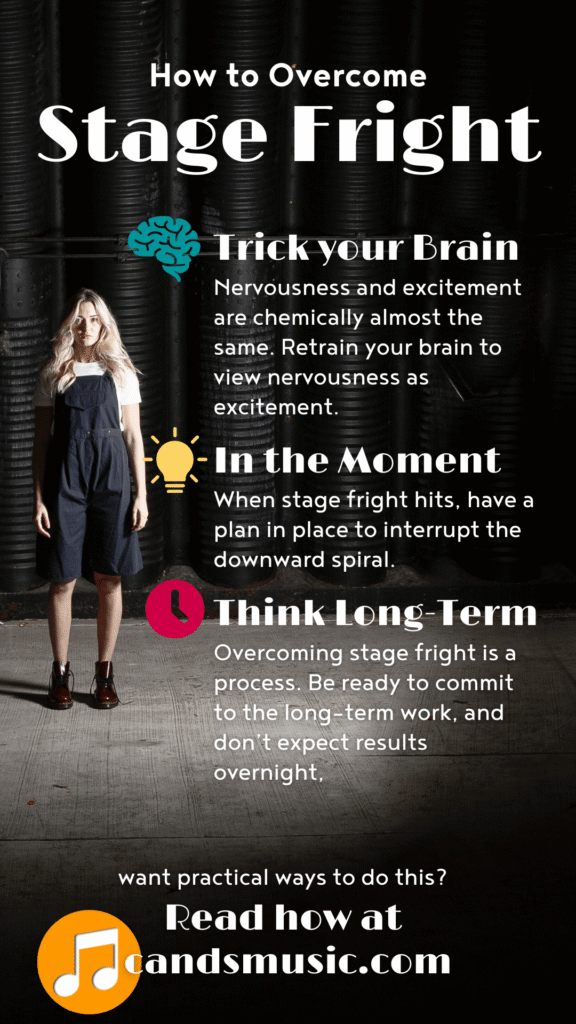
Here’s a fun fact for you: our bodies respond to nervousness and excitement in the same way. Chemically, the two are almost identical. While at first blush that seems inconvenient and likely problematic, we can use this little bit of info as a kind of “cheat code” when on the journey to overcoming stage fright.
Simon Sinek teaches public speakers to take advantage of the similarity between nervousness and excitement when facing stage fright for speaking engagements: when you’re feeling nervous, you can trick your brain into thinking that it’s excited instead!
Some ways to move from Nervousness to Excitement:
Mental Discipline
Since nervousness and excitement have very similar chemical makeups, the physical symptoms are also very similar: elevated heart rate, sweating, envisioning the future, etc. When you experience those symptoms, practice telling yourself (often out loud) that you are excited. When you are envisioning the future, try to discipline those thoughts to the positive.
Shift your Focus
When we are nervous, we are often focused on ourselves – our fears, our dreams, our expectations. Find something other than yourself to focus on: the music, audience experience, connection with the musicians around you.
Practice a Growth Mindset
This is especially important for those who struggle with perfectionism. Each performance is not a test of the learning process, but a part of it. Looking at performances as a growth opportunity can take the pressure off of delivering perfection.
Prepare, prepare, prepare
The more prepared you are, the less nerves will affect you, but you also have your practice to fall back on. When you know you did all you could, it’s easier to see the resulting performance as the best you can do.
Practical Strategies to Calm Performance Nerves
The above is all well and good, but they are all much easier said than done. Here are some concrete, practical things you can do to calm performance nerves:
Before the Performance
- Practice, practice, practice
Yes, this again. One of the best things you can do to combat stage fright is being prepared. When you know your piece(s) like the back of your hand, muscle memory can make the performance work even if you are nervous; and even just knowing that can help calm performance nerves. - Practice under performance conditions
Play for your friends, record yourself, find a stage to practice on… getting some littler “performances” out of the way will help with day-of jitters. - Establish a pre-show routine
Warmups, breath work, stretching, grounding, etc. are all great for calming your body and getting it ready for a performance, but practicing that routine on a regular basis before the performance will help your brain understand that those things signal just another practice opportunity.
In the Moment
- Use Grounding Techniques
There are a lot of different grounding techniques that work really well; they are exercises designed to, as the name implies, ground your mind in the present. Here is a list of some popular grounding techniques for you to try when you’re getting ready to go on stage. - Focus on the Music
When we talk about grounding techniques, they are all things you can do to keep your mind focused on the present, rather than fear, potential danger, or trauma. In my experience, there are few things more grounding than music. In fact, a lot of grounding techniques outside of the arts have to do with playing an instrument or listening to a favorite song. All that to say, you can utilize your music and its emotional pull to occupy your thoughts and ground yourself.
- Accept Small Mistakes
This one is hard, and one that really only provides success after “failing through” a few times. In my first time performing completely solo, I made some mistakes and froze – momentarily. In that moment, I knew that I had no other choice but to push through and continue playing. I had to make the choice to keep moving, no matter what. And now? After years of performing solo, I still make mistakes, but they don’t make me freeze anymore. I got more flexible as a performer and accepted that mistakes come – a huge, giant, enormous step to overcoming stage fright!
After the Performance
- Wait to reflect
This one feels a little counter-intuitive, but I had a mentor insist on it: no assessing the performance while still on the grounds. That includes mid-performance up to the second you drive off the property at the end of the evening. It’s tempting to start reflections right when mistakes are made, or chat with your fellow performers after getting off stage, but keeping performance and assessment so physically separate is very helpful! - Reflect gently
First rule? Don’t be mean. Berating yourself for mistakes made will only hurt your next performance and make your stage fright worse. Instead, be constructive. Note what went well, and note ways you can improve for next time. - Celebrate wins!
In reflection, make sure to enthusiastically celebrate your wins! If nothing else, make sure to celebrate your courage for getting up in front of people and performing.
Overcoming Stage Fright in the Long Term
We’ve talked about some practical ways to deal with stage fright in the here and now, but stage fright is not just a “here and now” problem – it’s our body’s response to stress, fear, and danger. In order to have long term success in overcoming stage fright, we need to train our body that a performance is not the danger we perceive it to be.
Consistent exposure therapy
As scary as it sounds, the best way to teach your brain that performance is a fight-or-flight kind of situation is to consistently perform. As you get more performances under your belt, it will become more normal, and your nerves will adjust. You may not ever be fully free from stage fright, but its effects will definitely lessen.
Healthy Body = Healthy Mind
Practicing healthy stress management in your daily life can help your body learn to respond to bigger stressors, like performing, in healthier ways. Find coping mechanisms that work to help lower your overall stress to learn what kinds of things might work for overcoming stage fright, as well as lower your baseline stress level.
Healthy Lifestyle
Let me start this one out by saying: drinking lots of water will not get rid of your stage fright. However, things like hydration, sleep quality, and nutrition affect your overall mental health, and making sure those are taken care of just reduces the number of variables to look at when overcoming stage fright. So get some exercise, drink lots of water, prioritize sleep, and eat your veggies!
Seek Community
One of the most powerful lies we believe is that we are alone in our troubles. I’m here to tell you that the vast majority of musicians have dealt with (or do deal with) stage fright to some degree. Try to find a performance community where you can share struggles & successes, support one another, and grow together.
When to Seek Extra Help
Yes, stage fright is normal, and yes, most musicians will experience it at some point in their career. What isn’t normal, however, is nerves so strong that it fully stops you from performing or even enjoying music. If you’re at that point, it’s ok to ask for some professional help in overcoming stage fright. A therapist or performance coach can resource you and help you get to the root of your fears so you can deal with them and enjoy sharing your craft!
Overcoming stage fright is not a one-size fits all thing, but it is a (pretty much) universal experience.
When you are experiencing stage fright, know that there are hundreds (thousands? millions?) of musicians who have gone before you and dealt with the same exact thing. Stage fright doesn’t mean that you aren’t meant to perform, it just means that you care. And that’s a good thing! We just need to figure out how to navigate that fear and turn it into fuel for a great performance.
Do you have any tips for overcoming stage fright that have worked for you? Share them in the comments!