

This post may contain affiliate links.
Most people think a musician’s job is simple: practice, perform, and record music.
However, in reality, professional musicians often spend as much time running a business as they do making music, if not more (especially if you’re going the entrepreneurial route).
Yes, the musical skills are important. Of course they are. But no matter how good of a musician you are, building a career in the music industry is dependent on skills that aren’t usually included in a traditional musician job description – this goes for all music professionals from teachers to session musicians and everyone in between.
So let’s talk about it.
What Is the Expected Musician Job Description?
If you search for a musician job description, you’ll usually find a list of responsibilities centered around making music, like performance, teaching, recording, etc. While those are certainly important parts of the job, it only scratches the surface.
At its most basic, a musician is someone who creates, performs, rehearses, or teaches music professionally (meaning they get paid, whether for part or all of their income). Depending on their career path, musicians may perform live, record in a studio, compose original music, teach private lessons, accompany choirs, play in an orchestra, work as freelance artists for a variety of clients, or even more (see this post for a more comprehensive list of career opportunities in the music industry).
A musician’s primary responsibility is to use their musical skills to entertain, educate, inspire, or support others through music. However, how they accomplish that goal varies widely depending on the type of musician they are and whether they work for an organization or run their own business.
All of these things are incredibly important and a big part of the musician’s job description – they are often the reason people decide to make a career for themselves in music. However, they only tell part of the story.
The Hidden Job Description of a Modern Musician
One of the most important and most surprising lessons I had to learn when jumping into the music industry is how much of the job isn’t just music. I wanted to be a professional musician because I love making music, I love teaching it, and I was good at it. Shouldn’t that be enough?
Here’s the thing – no job is just one thing outside of the music industry. How much more you have to do can vary depending on type of employment, pay scale, etc, but there are necessary skills outside of your discipline no matter what you do. Add to that the entrepreneurial/sole-prop nature of many music careers (and the speed at which technology is changing) and the list of skills you need for success grows exponentially.
The Job Description Has Changed
Years ago, many musicians built careers by working for a single employer, such as an orchestra, school, or church. While those opportunities still exist, today’s music industry offers many more ways to earn a living.
As a result, the modern musician often wears multiple hats. In addition to being a performer or teacher, they may also be:
- A business owner
- A marketer
- A website manager
- A content creator
- A social media manager
- A bookkeeper
- A customer service representative
- A salesperson
- A project manager
For many musicians, these responsibilities aren’t optional; they’re essential to building a sustainable career.
But.
Most musicians aren’t taught these skills. Even worse, many don’t even give them a second thought until they are thrown into the deep end of music industry (like me). Many talented musicians struggle not because they lack musical ability, but because they were never taught the business, technology, and communication skills that today’s music industry demands.
Quick caveat here: some of these responsibilities/skills can be outsourced, but that requires (good) money. If you can afford it, great! If not, that’s ok. These skills are still valuable for you to build as you grow as a musician.
Let’s take a look at the hidden job description of modern musicians.
Marketing
Many talented musicians struggle because no one knows they exist. That’s a problem that Marketing savvy can help fix. Even before you land a gig or a job, there has to be material at work showing you off as a musician and convincing people that they should hire you like:
- Branding
Consistent branding can be really helpful when trying to gain a following – a recognizable brand makes it easier for your fans to find you wherever they are. - Social Media
Social media marketing is a big deal nowadays. Solid social pages can be a huge asset in growing & engaging a fan base, showcasing your talent, and networking, not to mention the value that local social media groups can offer. - Email Marketing
No, email marketing is not dead. While social media is a big deal for those on it, there is a large demographic who are not on social media and value email blasts. It does, however, require a very different approach and strategy than social media marketing. - Website
Yes, you need a website. It needs to look nice, have all of your important information on it (bio, contact info, pricing, services offered), and if you really want to get the most out of it, include booking links and optimize it for search engines (more on that below). Check out this free guide if you want help building your website. - Blogging
Personally, I love blogging. Long-form text content like this post you’re reading now is my personal favorite kind of content to make because I can jam-pack it full of good info for you guys, it helps me with organic search (more on that below), and doesn’t get lost in the short-term media cycle. - Portfolio creation
A digital portfolio has been industry standard for a long time now, and the quality of your work is important – it’s basically a digital resume. That may be a demo reel, performance videos, etc, but the quality of production is as important as the quality of your skill – poor production hides talent.
Do you need to do all of these? Absolutely not. But you need some sort of marketing strategy to get your work and/or services in front of people. Usually this means having a solid portfolio, somewhere to showcase it, and some way to promote it. Maybe you build a website for your portfolio and promote it on social media. Maybe you build a booking site and promote it via email to book students.
There are lots of combinations of options, but you need to find effective ways to sell your services.
Understanding SEO
Now for one that will never show up on a musician job description: SEO, or Search Engine Optimization, is key for anyone selling anything online (yes, even your music). I have a blog post deeper into the world of SEO for musicians, but here’s the bottom line:
You need to understand how to build your website, social media pages, YouTube page, google business listing in a way that will put it in front of people when they search.
The approach for each platform/search engine differs slightly, and for your intended audience (are you looking for gigs? In what geographical area? Music students? for which instrument? This all matters), but the basic idea is the same: use words on your website, social media pages, etc, that your target audience is typing into google to find people like you.
There is nuance to good “keyword research” – or finding out what people are asking google – and it can take a little while to get the hang of it. I’m currently working on a course to walk musicians through the basics of SEO, but until then I made a killer resource for you to use for free: an extensive list of phrases that prospective music students are searching on google right now. I just have a version specifically for music teachers as of right now, but plan on having one for gigging musicians very soon – leave your contact info below to join the waitlist:
Networking
Even while not always specifically stated, this is one of the reasons musicians recommend going to a music school – the connections you make at music school are arguably the most valuable asset you bring away. You start businesses together, refer one another to jobs, and generally support one another’s careers based on the relationships you form in school.
Of course, learning to network is very possible outside of school, it just takes a little bit more legwork. That might look like:
- Collab projects
- Attending conferences
- Joining local music communities
- Joining music organizations
- Reaching out
- Following up
In truth, networking and marketing go hand in hand. If you just sit at home and wait for people to come find you to make connections, the process will move slowly if at all. It requires you putting yourself out there, making the first move, following up, maybe even providing opportunities for others.
It is a little scary, you will face rejection, but the best jobs come from trusted connections – you need to make connections and help them trust you before those jobs come.
Sales Skills
Many musicians dislike selling. I am right there with you. I would much rather just play my music or write my blogs and have you all find me and like me. But that’s just not the way our world works.
No matter what part of the music industry you fall under, sales is part of every musician job description, whether explicitly stated or not. Maybe you’re selling…
- lessons
- performances
- recordings
- concerts
- courses
- sheet music
- yourself
- … or more
No matter what way you slice it, if you’re a part of the music industry, you have to have the skills to communicate value, handle objections, ask for referrals, set pricing… you need to be able to convince people to pay for you to do whatever it is you want to do. That’s sales.
Technology Skills
Even since I was in school, this section of a musician job description has changed a lot. Tech is evolving quickly, and the tech skills needed for just baseline music work (let alone entrepreneurship) have skyrocketed. Some of the biggest are:
- Audio Recording
If you’re going to be selling your sound, you better make sure it sounds good. Poor production has a lot of power to kill a musicians career. Knowing your way around DAWs, mixing, mastering, and having the right equipment can make or break a musician today. - Video Recording
Like it or not, video is an important aspect to a musician’s resume today. At the very least, potential employers like to see stage presence clearly and without distractions. And if you aren’t recording yourself, chances are you’ll be recording someone else. - Website management
Luckily, most website builders today (WordPress, Squarespace, Wix, etc.) don’t require the kind of updating that coded websites do, and they definitely don’t require specialized knowledge to build or maintain. However, if you are going to run your own website, you need to keep up on basic maintenance: keeping information correct and up-to-date, keeping up on inquiries or bookings through the site, keeping links up to date and functional, etc. A hugely underrated part of website maintenance is monitoring your site analytics – know what is working, what isn’t, and adjust accordingly.
As someone who focused on classical music for the majority of my school career, tech skills like these were ones I needed to learn on-the-fly.
Financial Skills
Ok, yes, I agree that basic financial skills need to be taught in schools, no matter the career. Are they? Nope. It’s on us (you!) to learn them. That includes:
- Budgeting
- Taxes
- Bookkeeping
- Invoicing
No matter where you are in the music industry (or if you decide to pivot one day), these skills are invaluable for success in life in general.
There is another aspect of this, though – one that is music-industry specific. Contracts, royalties, and licensing all have their own financial implications that you need to know if you will be working with them.
Project Management
Ok, we are solidly in the “everyone should have this skill” section of this discussion now. No matter how many jobs, goals, or people you are managing at once, good project management and time management is one of the key differences between success and failure. Heck, as a (mostly) stay-at-home mom, this has been the majority of my job.
If we’re being real, though, most people in the music industry have to manage far more than just themselves. Maybe they juggle multiple projects (live gigs, recordings, lessons), maybe they manage other musicians (rehearsals, contracts, launches), maybe they have multiple clients (scheduling, preparing, invoicing) – maybe all of the above. Either way, project management is a crucial part of the musician job description.
Communication
Ok, this is the last of the “everyone needs this” section. You need to be able to communicate with people. No matter who you’re doing it with (employers, other musicians, students, their parents…) clear communication is essential.
That means building writing skills, speaking skills, and enough knowledge about yourself and your craft to be able to communicate it to others without worry of misrepresentation.
Entrepreneurship
Let me be clear: not everyone in the music industry is entrepreneurial. In fact, there are lots of jobs in the music industry that offer the stability of a regular office job. Despite that, many, many musicians would classify themselves as a musician entrepreneur.
There are a couple of different ways to define entrepreneur, but for our purposes it means someone with multiple streams of income.
You have heard it said that it’s hard to make a living as a musician. To an extent, that’s true. But many musicians are able to build a comfortable life for themselves (and keep things interesting) by making money in multiple, part-time ways. This may include:
- Teaching
- Digital products
- Courses
- Memberships
- Affiliate marketing
- Session work
- Licensing
- Sponsorships
- YouTube
- Patreon
No, you can’t do all of these (or if you can, color me incredulous), but you can pick a few and use them to build your income up to full-time.
Adaptability
Ok, this is one that I have found to be absolutely crazy. Just with the speed at which technology is evolving, I have had 3 or 4 major changes in my studio in the past 8-ish years all because of changing technology and marketing needs – not the least of which was the switch to fully digital payments (can you believe that the departure from cash and checks just happened in the last decade?).
So yes, technology is evolving faster than it ever has (AI, anyone?), and the industry changes with it.
However, I think this goes beyond tech. The music industry requires a resilience and adaptability to be relevant; you need to be continuously learning and pivoting when failures come – and they will come.
The Skills Most Important in 2026
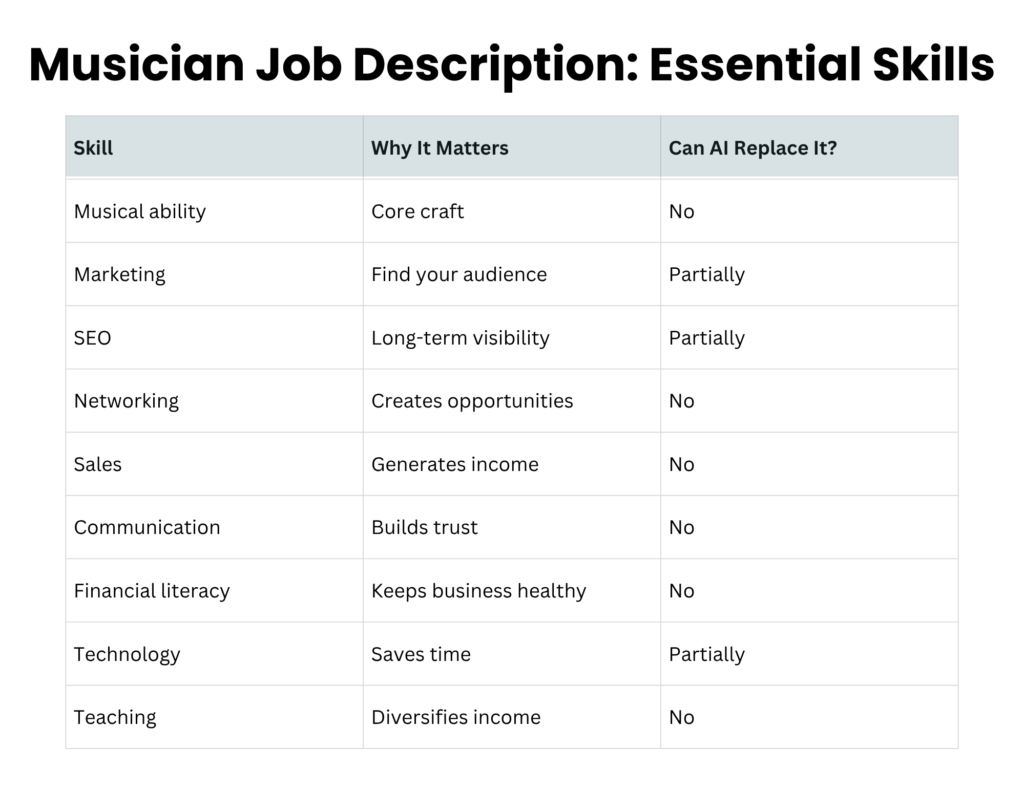
I didn’t come here to talk about AI – maybe I’ll write about it in the future, but here’s a good start – but it is an important part of the discussion when we are talking career skills in the music industry. Like it or not, people are turning to AI for shortcuts and saving money rather than hiring real people. However, these skill still stand strong and not only set you up for success, but many of them cannot be replaced by AI, at least well. That means you can’t use them for yourself, but others can’t either.
FAQ
What business skills do professional musicians need?
Professional musicians need far more than musical ability to build a successful career. Business skills like marketing, networking, sales, communication, financial management, project management, and website management help musicians find clients, manage their workload, and build sustainable careers. Even musicians who work for an employer benefit from understanding these skills, while self-employed musicians rely on them every day.
Can musicians be entrepreneurs?
Absolutely. In fact, many professional musicians are entrepreneurs, whether they realize it or not. A musician entrepreneur often earns income from multiple sources instead of relying on a single employer. This might include teaching lessons, performing, selling digital products, creating online courses, licensing music, affiliate marketing, YouTube, memberships, session work, or more (there are lots of job opportunities within the music industry). Diversifying income can provide greater financial stability while allowing musicians to pursue multiple passions.
Do musicians need marketing skills?
Yes. No matter how talented you are, people have to know you exist before they can hire you. Marketing helps musicians build an audience, showcase their work, and attract students, clients, or fans. Whether through a website, social media, email marketing, blogging, or a professional portfolio, having a marketing strategy is essential for growing a music career.
Why should musicians learn SEO?
Search engine optimization (SEO) helps musicians get discovered online by the people already searching for their services. Whether you’re promoting music lessons, booking live performances, or growing your audience, SEO can improve your visibility in search engines like Google and YouTube. Learning the basics of keyword research and website optimization can create a steady stream of potential clients without relying solely on social media.
What skills help musicians earn more money?
While strong musical ability is the foundation of any music career, additional skills often have the biggest impact on earning potential. Marketing, networking, sales, communication, financial management, technology, and entrepreneurship all help musicians find more opportunities, serve more clients, and develop additional income streams. Combining musical excellence with business knowledge can significantly increase long-term earning potential.
Is coding useful for musicians?
Most musicians don’t need to become software developers, but basic technical skills can be incredibly valuable. Understanding how to manage a website, troubleshoot common issues, use digital tools, and automate repetitive tasks can save time and money. As technology continues to evolve, musicians who are comfortable learning new tools are often better equipped to adapt and grow their careers.
How do professional musicians build multiple income streams?
Many professional musicians combine several complementary sources of income instead of relying on a single paycheck. For example, a musician might teach private lessons, perform live, record session work, sell digital products, create online courses, earn affiliate income, license original music, or build a membership community. Developing multiple income streams can create greater financial stability while making a music career more resilient to industry changes.