


This post may contain affiliate links.
Hey singers! How often do you practice?
And maybe a better question… how do you practice?
Sing songs? Work problem sections? Scales? Breath work?
And another question… do you know why you’re doing those things (if you are)?
No matter your singing goals, some sort of of regular vocal routine is incredibly important. It’s something I build for each of my students, and continue to tweak as their skills and goals change. The time they spend between lessons needs to be intentional and helpful; practice time is where most of the work happens! So let’s talk all about Singing Routines!
Why should you establish a daily vocal routine?
Whether you’re a hobby singer, pursuing a singing career, or are just someone who talks a lot (or some combination!) I think the main reason to establish a daily vocal routine is for longevity. I’ve seen so many hobby singers give it up in the event of improper use or injury just because they didn’t maintain their vocal health. Vocal injury is very real and can be irreversible if not approached with care – it’s better to just avoid it at all costs!
Just like any other muscle, the voice (and the muscles engaged in using the voice) need to be stretched and exercised regularly (and before heavy use!) to maintain health, prevent injury, and improve. A high-quality, regular singing routine will do just that – keep the voice limber and ready to be used, as well as help the singer to improve problem areas.
I highly recommend working with a professional (vocal coach, teacher, etc) who is familiar with vocal pedagogy to help you build a healthy vocal warm up routine, but we know that not everyone has access to someone like that! We offer what we call “micro lessons,” that can be used for just that – you send in a video of your singing, and I will personally get a plan together for you. Here are some of the elements that need to be included in a good singing routine:
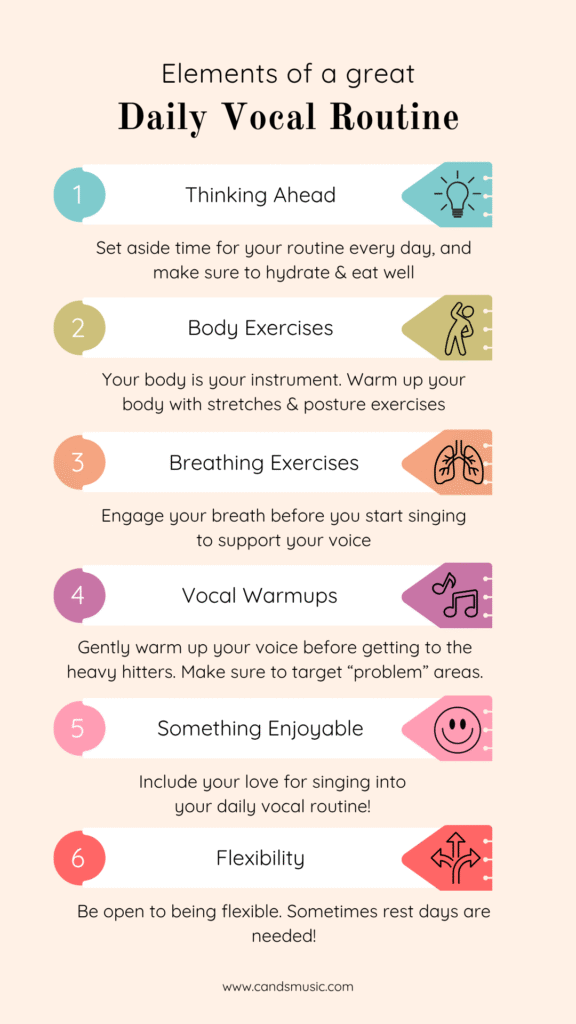
Elements of a good daily vocal routine
- Think ahead
We know that it’s important for vocal health to be hydrated and avoid problematic food (both in the name of mucus reduction), but here’s the thing: effects are not always immediate, and adverse effects like increased mucus can hang around for even a few days. So if you have a heavy singing day coming up, you need to think at least a day ahead, if not more. Even better, consistent lifestyle changes can make a huge impact on your baseline vocal health.
In the vein of thinking ahead, have you heard the idiom, “tasks fill the time you give them”? If you want to establish a daily singing practice routine, you are going to need to make time for it, or that space in your schedule will be filled with other things. - Body exercises
As singers, our body is our instrument. While we don’t have to be in peak physical condition, body awareness and proper posture both have a huge impact on our ability to use our voice (read more about the body’s impact on the voice in this post). Some light stretching and posture exercises should be included in a daily vocal routine. - Breathing exercises
It’s no secret that breath work is extremely important for singers. Before singing, exercises to engage the muscles responsible for breath control and practice proper breath support do a lot of the heavy lifting needed to prevent injury and support healthy singing. - A solid vocal warmup routine
Of course, you can’t have a good daily singing routine without a good vocal warmup routine. Gentle exercises like lip trills or sirens are a good place to start, then exercises for each part of your range. As you get to know your voice, you can add in exercises for placement, agility, and vibrato. I highly recommend working with a teacher to at least get some good vocal exercises (and learn how to do them healthily), but I have a list of my favorite vocal warm ups on this page for a good starting point, or check out one of my favorite singing resources on the internet – Cheryl Porter’s YouTube page! - Something enjoyable
Why do we sing? Because we love it! Maybe it’s the emotional expression, maybe it’s the body connection, maybe it’s something else, but there is some aspect of singing that makes you want to do it. Make sure you include something you love in your daily singing practice routine to cultivate that love. It can be a favorite song, it could be an exercise, it could even be a place you like to sing. Get creative with it, even switch it up, so your routine doesn’t get too stale. - Flexibility
Illness happens. Bad days happen. Busy days happen. Recovery days are necessary. Exercise wisdom and make adjustments to your routine as needed. You can work with a teacher to figure out what this looks like, but if you’re on this journey on your own, here are some ways you can care for your voice when you are at less than optimal performance.
An example: my vocal routine
Like I mentioned in the “flexibility” section above, my vocal routine not only looks different day-to-day, depending on if I’m teaching, performing, or just practicing that day. And some days are rest days! But overall, I include:
- Lots o’ water – I always, always, always have water with me, especially when I am going to be practicing.
- Light stretching – head rolls, shoulder rolls, forward bends
- Breath work – lying down belly breaths, square breathing (read how to do those here)
- Vocal Exercises – yawns, lip trill sirens, regular sirens; descending scales, ascending scales, and 5-9 agility exercises on a lip trill, with straw phonation, and/or various vowels (read about some of those here) If I have a specific problem with placement, intonation, or breath in a performance piece, I will add in exercises to target that problem.
- Something enjoyable – for me, that often entails accompanying myself on a few songs on the piano.
How to find a vocal routine that works for you
Let me reiterate – I highly, highly recommend working with a teacher to get a good daily singing practice routine going. They can listen for problem areas and give you exercises to help as well as show you how to do them healthily. Even if you can’t commit to regular lessons, one or two lessons can make a huge difference in the quality of work you will be able to do. If that’s not something you have access to, you can try one of our micro-lessons, or shoot me an email!
All that to say, here are the things I asses when building a singing routine for someone:
- Skill level
How long have you been singing? What kind of singing? Have you been working with a (quality) teacher? - Voice Range
What is the singers full range? Where are they most comfortable? Where are their register shifts? Passagios? - Desired Genre
While most exercises are helpful for all genres, different genres ask for different treatment of consonants, vowels, and placements. Knowing what kind of genre the singer wants to train in can help me fine-tune the exercises to help them reach their goals. - Goals
Speaking of goals, what are the singer’s goals with their voice? A daily singing practice routine to extend their range will look very different from one to gain more vocal agility. - Problem Spot
This section is so broad, and one of the reasons practice routines change over time. The practice routine can target anything from breath support to vocal breaks to diction to agility to range… the list goes on. But I identify a problem spot (or two – it is not wise to try to tackle it all at once!) and assign exercises to target them.
So there you have it – all the aspects of a successful daily vocal routine to help prevent injury and improve your singing skills!
Maintaining your vocal health and ability with a high-quality routine can be a little complicated and involve a lot of pre-thought, but it doesn’t have to be. Hopefully this guide can help you get started on that journey and of course, if you need any guidance, my inbox is open.
Linking a daily routine to vocal longevity makes the advice feel more sustainable than treating practice as a last-minute warmup. The reminder to plan hydration and heavy-use days ahead is especially practical.