





Sight Singing 101
This is a structured, teacher-led sight singing curriculum designed to help students build confident pitch recognition, interval awareness, movable Do fluency, and practical musicianship through a sequential Kodály-informed approach.
Designed for:
- private music lessons
- voice studios
- homeschool music programs
- small group instruction
- beginner/intermediate musicianship training
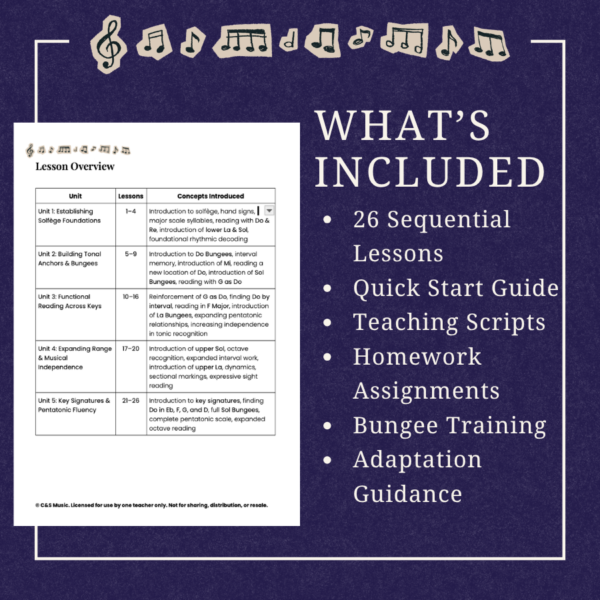
This 26-lesson curriculum provides teachers with a step-by-step framework for introducing solfege & hand signs, interval recognition, pentatonic sight singing, and foundational key signature reading in a practical, approachable sequence.
What Students Will Learn
By the end of this curriculum, students will be able to:
- Sing the major scale using movable Do solfege
- Recognize and sing pentatonic relationships by sight
- Read and perform beginner sight singing exercises independently
- Understand interval relationships through structured ear training
- Approach unfamiliar music with a repeatable sight singing process
- Identify tonic relationships across multiple keys
What’s Included
- 26 sequential lessons
- A Quick Start Guide
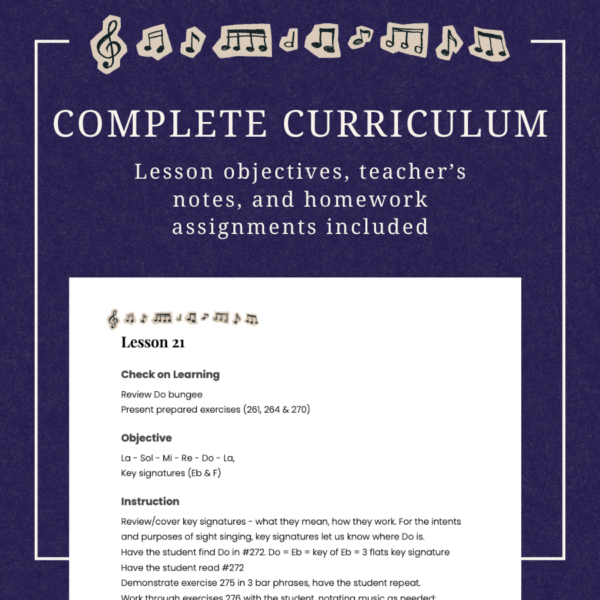
- Teaching instructions for each lesson
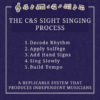
- Guidance through the C&S sight singing process
- Homework assignments
- Solfege & hand sign integration
- Interval exercises
- Teacher notes and pacing guidance
- Approximately 6 months of instruction
Student Prerequisites
Before beginning this curriculum, students should have a working understanding of:
- Basic time signatures (2/4, 3/4, 4/4, 6/8)
- Basic note values (sixteenth note through whole note)
- Basic rest values
- Staff reading fundamentals (note names, clefs, etc.)
Teacher Prerequisites
Teachers using this curriculum should be comfortable with:
- Basic rhythm and time signature instruction
- Standard music notation
- Solfege syllables and hand signs
- Introductory interval recognition
- Basic key signature reading
- Scale tone identification using both letter names and solfege
This curriculum is written for teachers with foundational musicianship knowledge, but does not require advanced theory training.
Required Resource
This curriculum is designed for use alongside:
333 Reading Exercises: Choral Method by Zoltán Kodály
Teaching Philosophy
This curriculum uses a sequential, interval-based approach designed to reduce overwhelm and strengthen long-term pitch recognition through repetition, movement, pattern recognition, and practical application.
Students first internalize tonal relationships through pentatonic patterns before expanding into broader key recognition and intervallic reading.
The goal is to build a foundation of independent musical literacy that will carry your student through further musical training.



PJ –
I was given early access- here are my thoughts.
As a teacher sometimes I pick up a student and I need a bulletproof lesson plan to take them through. I have one for piano, guitar, low brass, high brass, and now sight singing. As an instrumentalist by trade it’s been difficult for me to put what I learned in college (all those long years ago) into a repeatable lesson plan.
Well now I’m saved. C&S has done it again. Lesson plan? Done. Homework? Done. Do yourself a favor and save the time and energy you deserve to have back.