
This post may contain affiliate links.
Ah, yes, the age old question: do Vocalists need to learn music theory?
Especially outside of the (professional) music world, Music Theory is most associated with instrumentalists and composers, and when contemplating a singing career, music theory is largely left out of the thought process.
In the worst cases, music theory for vocalists is looked down upon in disdain, as a waste of time and resources. Why learn music theory if I just want to sing?
If that’s you, stick around and hear me out.
A basic level of music theory for vocalists is arguably the best thing a singer can do for learning their craft, collaborating with other musicians, and increasing their professional versatility.
Here’s the thing: I’m not going to tell you that Music Theory is necessary for vocalists, especially for those that aren’t pursuing a career in music. But Music Theory is the biggest and best tool for whole-person growth as a musician. So let’s talk about it!
What is Music Theory?
If we are going to talk about Music as a language (a series of sounds that conveys ideas and emotions, with grammar-like rules & notation to allow transferring of information), Music Theory is the alphabet, phonics, and grammar; it’s everything that makes the language of music able to be understood and communicated.
In more practical terms, Music Theory includes both notation (the staff, time signatures, notes, rests, dynamic markings, keys, chords, etc) and theory (keys, scales, chords, functions, cadences; understanding why things sound good or don’t).
Music Theory for Vocalists: how it helps
When it comes to music theory for vocalists, whether you’re looking to pursue a career in music or just enjoy it as a hobby, there are so many ways that even baseline knowledge helps you to become a better singer & musician!
- Music Theory helps you understand music better
Let’s keep talking about music in terms of language. You could read a story or a poem in a language other than your native tongue, and you can maybe get some meaning from the words (if you listen to someone else read it, who is fluent, you can pick up on more meaning), but you really don’t understand the point of the piece, and you absolutely need someone’s help to learn what it says. - Music Theory is the ultimate collaborative tool
When a group of musicians (and yes, I’m including singers in this) gets together to play a song, they’re all entering into telling a story together – in a language not their own. Those who are fluent in that language can not only understand what’s happening in the story, but they can communicate it effectively to others, and talk with band mates (who are also fluent) about ways to make the story better. If you don’t understand the language, there is little you can bring to the table in terms of collaboration, no matter how good your voice is – and you will understand very little being said.
This analogy takes a whole other level when we get into songwriting – if you write a song and want to be able to help others play it well, you need to speak the language of music at least a little bit. Music theory allows us to really speak the language of music fluently, and communicate well with others who do as well. - Music Theory helps you write good songs
Speaking of songwriting, it is so hard to write anything remotely understandable in a language that you don’t speak. If you just want to write songs for yourself, go for it. But if you want to share your music with the world, having a basic working knowledge of music theory not only makes it easier, but helps you to write in a language others will understand. - Music Theory opens professional doors
I have seen many, many singers lose out on opportunities because of their lack of music theory knowledge. (which the idea that those who opt to hire musicians with theory knowledge instead not letting those singers know, just to save their feelings, is a whole other issue that adds to this problem of singers thinking they don’t need music theory). This one is closely related to #1 – musicians want to work with other musicians who are easy to communicate with. - Music Theory makes you a more versatile musician
Sure, you love singing now. You probably will love it forever! But what happens when you decide you want to try another musical avenue? A foundational knowledge of music theory will help make the jump from voice to guitar or piano much, much easier. - Music Theory makes you a more independent learner
The more fluent you are in the language of music, the easier time you have learning on your own. You don’t need a video, app, or teacher to “interpret” for you all the time, so you can learn/study a piece on your own! - Music Theory breaks through vocal plateaus
Yes, you can sing without knowing music theory – to a point. If you’re looking to make a career out of singing, there will be a point where music theory knowledge will be expected (I can’t tell you how may vocalists struggled in my music theory classes in college). If you’re not pursuing a career, though, and are a hobbiest singer, even basic music theory can still help you break through plateaus! Understanding keys and scales can help with ear training, intonation, and pursuing things like harmony and improvisation.
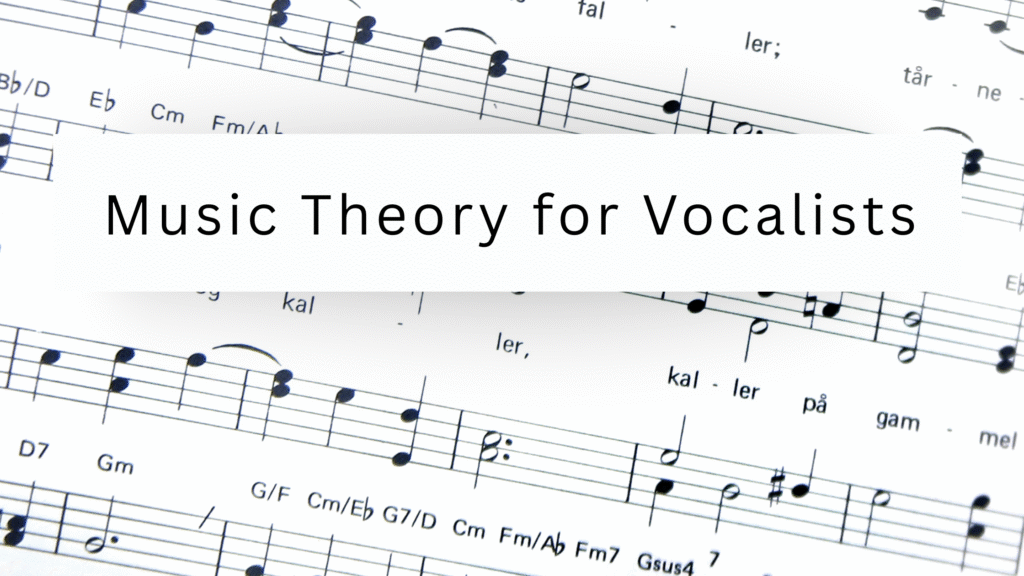
How do I learn music theory as a vocalist?
Ok, so far we’ve covered:
What is music theory?
Music Theory for Vocalists: how does it help?
You’ve stayed with me this far, so now we get to answer the question, “How do I learn music theory?” One of my favorite questions! Here’s why:
Like I said in the beginning of this post, the internet is surprisingly divided on the idea of music theory for vocalists. Some land in the camp of “not needed,” others (like me), say it’s one of the most helpful things vocalists can do for their craft. But this question is where I diverge from some of the crowd:
You don’t need a huge breadth of music theory knowledge as a singer. You don’t even necessarily need classical music theory (unless you’re pursuing classical voice). You can dive deeper, and I’ve found that many singers do once they start (which in turn spurs on growth and opens more professional doors), but a basic music theory foundation is all you need to start.
Learn Basic Music Theory Online with C&S Music!
For a limited time, you can get the first lesson of Theory for Singers completely free – I’ll send it directly to your inbox so you can decide if Theory for Singers is a good fit for you.
So how do you learn music theory? You start at the beginning. You start slow. You start small.
When it comes to the practical, there are lots of great resources at your disposal, both online and in person. Here are some great options:
- Online Courses
I would be remiss if I didn’t plug the course I wrote specifically because of this conversation. Theory for Singers is a learn-at-your-own pace basic pop music theory course that covers foundational music theory for vocalists looking to improve in the pop, country, and contemporary christian genres. Right now, I’m running a promotion where you get to try out the course for free – I will email you the first lesson so you can see if it’s right for your needs! Sign up now!
You can also check out sites like Coursera, that offer courses in music theory.
- Independent learning
Because of the nature of music theory, independent learning can be quite effective. There are lots of great resources on YouTube (Like David Bennett’s Welcome to Music Theory “course”), or apps like Tomplay allow for exploring scores and theory with moderate guidance. - A private teacher
If you are a vocalist and are taking private voice lessons, your teacher should be including Music Theory in your studies. If they aren’t, you can absolutely ask them to spend some time on it with you.
If you aren’t in lessons, and are wanting to improve as a singer, consider trying it out. There is no educational substitute for one-on-one learning! If you need help finding a good teacher in your area, shoot me an email – I would absolutely love to help.
So there you have it – my (pretty much) full thoughts on music theory for vocalists.
I will reiterate – I wouldn’t use the word necessary when talking about music theory for hobby vocalists. Professionally, it is handicapping yourself. But even if you aren’t pursuing a career, music theory can really take your music making to a whole new level of fun, understanding, and quality. If you have any thoughts on this that I may have missed, please leave a comment!