

This post may contain affiliate links.
Music teachers, we’ve all been there: you sign a new student who’s had some training, either at home or with another teacher, and they bring a piece to their first lesson to demonstrate where they are at.
And they perform beautifully. Technique is great, note accuracy is awesome, emotional expression all there. Great! You move on to evaluate their music theory & reading. You put a simple piece in front of them… and they freeze.
Despite their pristine performance, they have clearly had zero sight reading training, and have relied on playing by ear for their entire musical career. While that is a valuable skill, it limits them to repertoire (and the skill level) of the people around them, never allowing them to be their own musician.
They’ve been learning repertoire, not learning music.
Sight reading training is what allows music students to actually own their craft and become independent musicians and, if they want to pursue a career in music, marketable craftsmen. It’s what sets apart learning songs and being a musician.
The good news here is that sight reading is a learned skill. This means that every student of yours has the capacity to learn to sight read. That then begs the question: how?
How do we give our students a foundation of sight reading and music theory while still keeping time for repertoire and the more “fun” parts of music? I am so very glad you asked! After many years of teaching music (and implementing sight singing into every single lesson), I have arrived at a method and practical system that builds sight reading training into my private lessons and supplements learning rather than overtaking it.
Let’s talk about it!
Why Most Students Never Learn to Sight Read
I want to get this out of the way up top: while I absolutely believe that every music student should have at least basic sight reading training. I also understand why many teachers don’t prioritize it:
- It takes time.
Lesson time is valuable. To give up half of a lesson to something that doesn’t (on the surface) help with repertoire and performance goals seems too costly to many teachers and, frankly, many students. So it gets pushed to when there’s more time… which is never. - Students don’t like it.
Many times, students don’t see the value in learning to sight read. It is harder up front, and many can’t see the value that it builds for them down the line. - There aren’t many curriculum resources out there.
In your limited free time as a teacher, writing a sight singing curriculum that will work for your students is a tall order, and most of the pre-existing resources are not fully fleshed out. That leads to… - Haphazard approaches
Teaching a skill effectively requires consistency, method, structure, and progression. One-off lessons in sight singing don’t build the skills the students need, and they don’t develop as a by-product of simply playing repertoire.
Put some (or all) of these together, and you get a student who depends on their teacher (or YouTube) to teach them their pieces, instead of developing their own independent musicianship. Like I said above, this approach builds dependent players, not independent musicians.
The Two Pillars of Effective Sight Reading Training
After teaching sight reading to countless students over many years, I have come to realize that good sight reading training comes down to 2 main things:
Pillar 1: Ear Training (Audiation)
Did you know that the reason that students ask you to play a piece or section for them before they do is because they have no clue how it is supposed to sound?
They haven’t developed the skill of Audiation, or mentally hearing music from the page. There are many facets to audiation, but they all boil down to one thing: ear training. Teaching the brain what certain intervals sound like, and how they work together – either by sight or by ear.
This is why the Solfege system is so powerful (the system I use in my lessons, and am partial to) – it teaches the brain to think about each note as it relates to the others, and helping the student understand the bigger picture of music. It’s that kind of thinking that really creates a versatile, independent musician. It builds a strong internal sense of pitch relationships that is vital to reading music by sight.
Pillar 2: A Repeatable Methodology
As with most things, the journey matters as much as (if not more than) the destination in sight reading training. That means that the process & method needs to be consistent, helpful, and intentional for both the teacher and the student.
Sight reading has a number of different layers that need to be trained, each with their own challenges, and much like layering skills (like singing and playing an instrument simultaneously), each layer needs specific attention before putting them together. This includes things like rhythm, pitch, words (if singing), dynamics, tempo, etc. Treating each piece as a layer in your approach to sight reading training reduces overwhelm and teaches the student how to approach pieces independently – and with great success!
How to Fit Sight Reading Training Into a Private Lesson
I know that time constraints are an issue. In private lessons, every minute you have is valuable and you don’t want to waste half the lesson (or more!) on sight reading training. But I also know how important that training is, so here’s how I fit it into every lesson – even 30 minute lessons:
- Time budget.
I “budget” for 25%-33% of the lesson to be taken by sight singing exercises, and I stick to it. That means adjusting my lesson plan as needed to fit that time (even adding to it, though that’s rare). - Keep it predictable.
Keep it in the same spot for each lesson, and the same structure every time. That way the student knows exactly what to expect, which really cuts down on pushback. I tend towards using it between warmups and repertoire. - Don’t skip weeks.
In sight singing, consistency & quality is more important than minutes spent. When you are consistent, there will be less potential for having to play catch up in the lesson and eat up more valuable lesson time.
A note: these principles translate easily to group lessons! Incorporating sight reading training into your group lessons, especially voice, will not only benefit your students’ musicianship, but will help add structure and predictability to your lesson plans.
What Progression Should Look Like
A good sight singing curriculum should be, as we briefly touched on, logic & progressive. Each lesson should build on the last logically and pedagogically, helping the student to draw connections between different scale tones, intervals, rhythms, etc. In my methodology, that looks like:
- Starting small
I start my students on one interval: a major 2nd (Do and Re, or scale tones 1 and 2). Once that is solidified, we add a minor third (La, or scale tone 6 below the 1), and so on. - Using supplemental exercises
I use an additional exercise (that doubles as a pretty good warmup!) to reinforce intervallic relationships between the scale tones. It helps the students think intervallicaly and get those intervals into muscle memory quicker. - Waiting on keys/key signatures
Yes, finding the tonic is important. But the tonic is important because of its relationship with each of the other scale tones. Once those intervals are established, then we can talk about keys – because then the student understands what it means. - Using mini-progressions for exercises
When I have a student sight read a piece, I have them go through the same process every time for rhythms, pitches, tempos, etc. This is a small way to reinforce the progressive nature of learning music. - Taking the time the student needs
Last but MOST CERTAINLY not least, I don’t rush the student past where they are not ready. If they need an additional week (or two) on a lesson, I add exercises and give them another week. The goal in sight reading training is not finishing in a certain amount of time, but finishing thoroughly and well – that’s how we set our students up for success.
A Note on Solfege and the Kodály Method
I am personally (and professionally) partial to utilizing Solfege for sight reading training (don’t know what solfège is? This is the video I show to my students, followed by this one), and more specifically the Kodaly method. It is how I was taught, and it is how I teach each of my students. If you aren’t familiar with the method, there are a few key tenets that I believe lead to success:
- Engage all learning styles
The Kodaly method engages with each of the major learning styles: hand signs give the kinesthetic learners something grab on to, standard and modified sheet music (used in tandem) help the visual learners, and call and response, or repeating phrases after the instructor, is in each lesson to help the auditory learners. - Intervallic training translates better to real life
There is a harsh divide between solfège users on whether we should be teaching fixed do or movable do – meaning the do syllable is always C (fixed do), or it is always the tonic of whatever key you are in (movable do). If you want a fuller explanation of these concepts, this is a great article. For lots of different reasons, I believe movable do to be better for practical application, and the Kodaly method teaches that. - Progressive Learning
Like we’ve covered, any sort of training needs to be progressive, each lesson naturally building on each other. The Kodaly method includes slowly building in intervals and scale tones. - Emphasis on Folk Songs
Folk songs are written with “singability” in mind – easy melodies that the average Joe can latch on to. Using those kinds of songs makes the reading feel easier and more attainable to the student.
Signs Your Students Are Ready to Start Sight Reading Training
I think another reason teachers are hesitant to start their students on sight reading is because it feels advanced. Really, though, students just need a small foundation of music theory that is easily attainable. This is what I make sure my students know before I start teaching them sight singing:
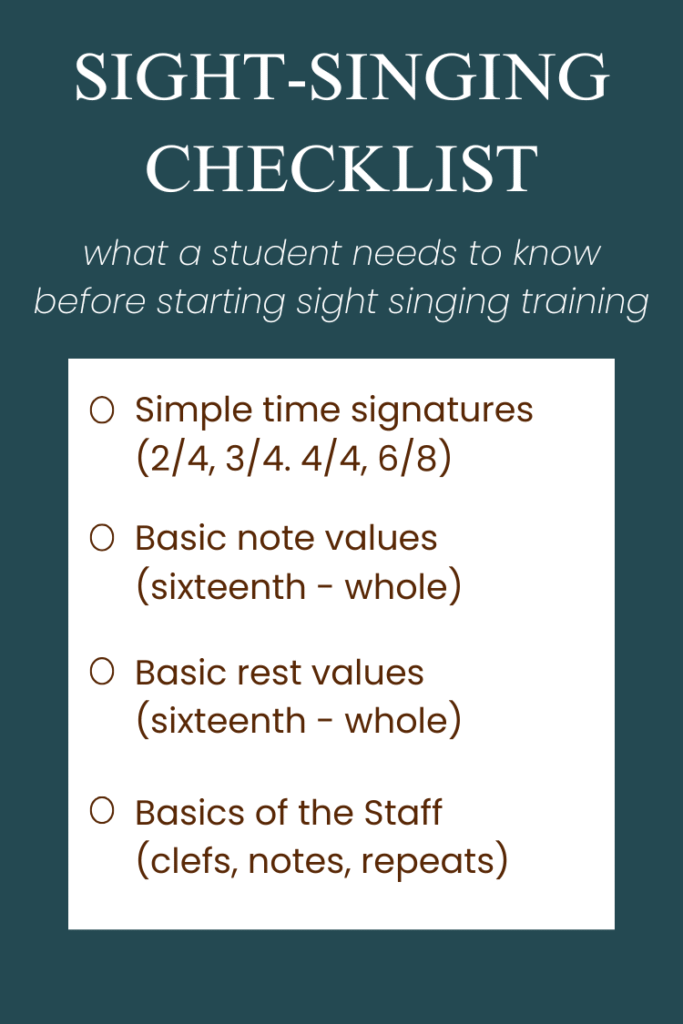
A basic, foundational Knowledge of traditional music theory is what I look for. And when I say basic, I mean basic. Simple time signatures, note and rest values, and some other theory notations like clefs, note names on the staff (or at least be able to work it out using line tricks or whatever else), and directional stuff like repeats, first and second endings, things like that.
Any other music theory knowledge that they have when starting sight reading training is just icing on the cake – you don’t need to wait to train “advanced” students, you can truly start beginners on sight singing as soon as they have those basics down. In fact, I recommend starting them as early as possible to start reinforcing intervallic relationships early so they can carry it through their growth as a singer!
Sight reading training should be simple, but that doesn’t mean it’s easy
The way I see it, private music teachers have two options if they would like to implement sight reading training into their lessons: spend lots of time and energy cobbling together a plan, or purchase a pre-written curriculum. And let me tell you, there are not many sight-singing specific curriculums out there, and I haven’t found any that have checked all the boxes I need with my students.
To help with that last difficulty, I am very excited to announce that I have packaged the exact system I use with my own students into a 6-month sight reading curriculum! It is designed to be plug-and-play, taking 10-20 minutes of lesson time per week and gives a complete progression from solfège basics through a full pentatonic scale, with teacher notes, homework assignments, and methodology all built in. At $3.88 a lesson (if you just use it for one student), that’s a steal!
Teach Your Students to Read Music with Confidence
Sight Singing 101 is part of the Confident Musician Series — a collection of practical musicianship curricula designed to help private music teachers develop independent, confident, and highly musical students.
If you decide to write your own curriculum, that’s awesome too. I am absolutely here as a resource if you need it, and my inbox is always open! alyssa.villagrana@candsmusic.com