


This post may contain affiliate links.
Spending good time practicing your instrument (an hour? hours?) and feel like you have nothing to show for it?
I think I can safely say, we’ve all been there.
As a (professional) musician and a (professional) music teacher, I’ve been there myself and walked alongside musicians in this frustration many, many times – more than I can count! It’s an experience common to all ages, instruments, and walks of life, and I have found that the advice online on how to deal with it is severely lacking.
No, I’m not just going to tell you to practice more. In fact, that most often does more harm than good. My mantra of choice when it comes to practicing is:
Practice smarter, not harder.
Me, a lot. I’m sure other people say it too 😉
And I’m going to walk you through how I do that, and how I teach my students to do that. So whether you are a traditional music student, self-taught, or already teaching others, looking for how to practice piano, guitar, singing, or any other instrument, you can practice smarter & help others to as well! We’re gonna talk:
- What to practice
- How to practice it
- Common mistakes
- & How to structure a practice session
What Does Effective Music Practice Look Like?
Before we learn how to practice music effectively, let’s define what it means. Effective music practice looks like…
- Practicing with a specific goal
- Identifying and working on problem areas
- Building accurate muscle memory
- Paying attention while playing
- Gradually increasing difficulty
- Making progress over time
If you can remember just one thing of what it means to practice music effectively, let it be this: effective music practice frees you up for emotional and artistic expression at a later time. If you do your job well in practice sessions, the artistry, collaboration, and fulfillment get to become the focus later.
10 Music Practice Tips That Actually Work
1. Set a Specific Goal & Time Limit for Each Practice Session
Instead of:
“I need to practice piano.”
Try:
“I’m going to learn measures 12–20 hands separately for 20 minutes.”
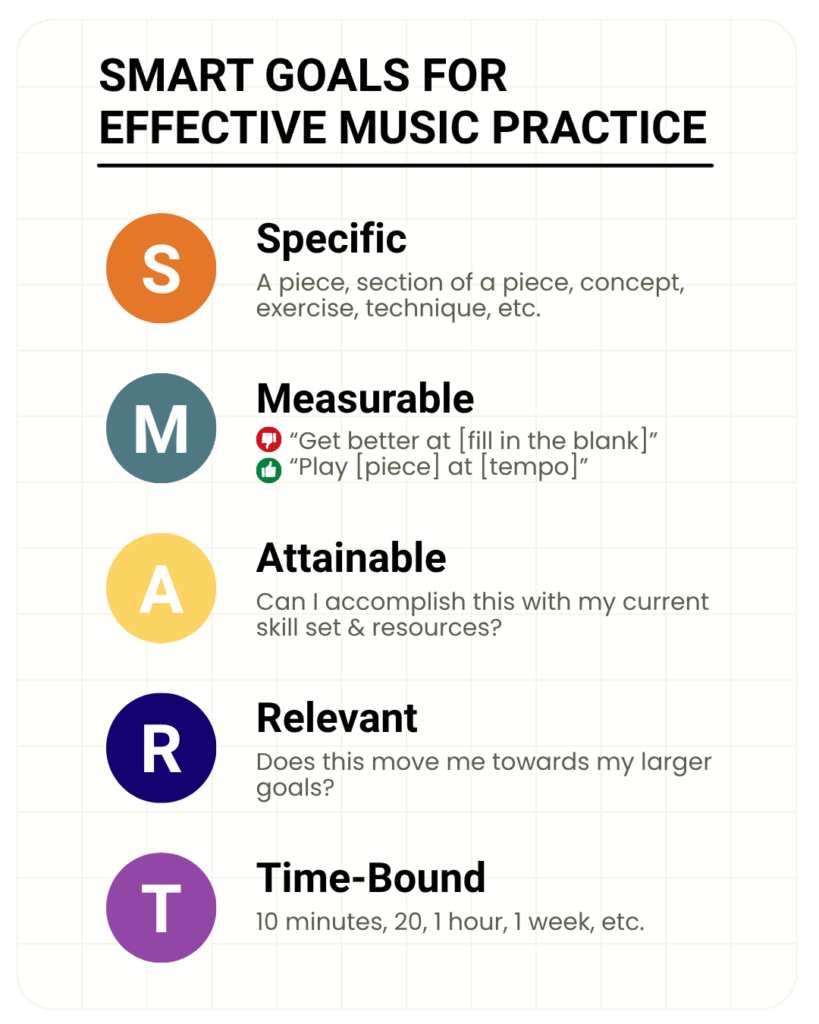
SMART goals are an important piece of business literature, but they absolutely apply here. Your practice sessions should have goals that are Specific, Measurable, Attainable, Relevant, and Time bound.
If you are working with a teacher, have them help you set these goals. Teachers, keep these parameters in mind when setting up practice trackers/logs or weekly assignments for your students. Set them up for success!
A tip within the music practice tip: use the time-bound aspect to set larger and smaller goals. Maybe your week-long goal is to learn a piece, your practice session goal is to increase the tempo, & your 5 minute goal can be one trouble measure.
2. Start by Warming Up
Yes, warming up is important. It’s not just for learning & enforcing technique in lessons (though it can be very helpful for that), it is first and foremost for you – to prevent injury and get your muscles (including your brain) ready. They can look like:
- Scales
- Technical exercises
- Vocal warmups (here are some of my favorites)
- Long tones
- Finger exercises
- Basic rhythm exercises
Much like an athlete stretching and doing light exercises to warm up his muscles, musicians need to do the same thing each time they approach their instrument, including practice. Get down a good warm up routine that is effective without taking up too much time – the ultimate goal is to get you ready for practice, not be the whole practice.
3. Break Music Into Smaller Sections
In performances, we run pieces top to bottom. But in order to do that effectively, we need to be practicing them piece by piece. They may be larger chunks if the piece is easier, but sectioning out pieces not only helps us isolate problem spots, but it gives us insight into the pieces structure and emotional journey. When you are confident in the smaller sections, start stringing them together to form the full picture.
4. Practice Slowly
I know that practicing slowly is just… not as much fun as up to tempo (or past – looking at some of my students there!), but failing to practice slowly poses a number of issues:
- Moving quickly can make you miss mistakes. Slowing down the piece and looking at each beat as it comes helps to increase accuracy.
- Speaking of accuracy – if you practice mistakes (because of rushing and not catching them), they will be 10x harder to rewrite. Practice is us telling our muscles what to do, or building muscle memory. Once they are taught the mistake, it gets really hard to overwrite.
If you are tempted to rush, use a metronome to keep your tempo slow. As you become familiar with the piece, gradually increase to the written tempo.
5. Practice active listening & ask good questions
One of the most valuable skills we can have as a musician is how to listen well. I can’t tell you the number of issues I have worked through with students that are solved by learning to listen, and listen well. And the starting point for listening well is asking (and answering) good questions, like:
- Did I make a mistake?
- Where did I make a mistake?
- What specifically caused the mistake?
- Is the problem rhythm, notes, fingering, coordination, breath, articulation, or something else?
I like to say that more than half the battle in learning a skill is knowing when you’ve made a mistake. The rest is knowing how to fix it. These questions get you (or your students) proactively thinking and listening with an ear primed to work through the mistakes you make.
6. Repeat Correctly
I mentioned this a little bit above, and this is a point I drive home constantly with all of my students: muscle memory is powerful. If you are repeating mistakes, you are building (wrong) muscle memory that will take even longer to correct. It is much better and more efficient to practice slowly (even a little boring) to build the right muscle memory first than to have to correct bad habits later.
So when you are drilling problem sections, don’t just mindlessly play them 20 times to “check the box.” A couple of intentional play-throughs (with active listening) will do you far better than passively playing a section or piece.
Another note on repetition: don’t just play a passage until you get it right one time. As I like to say to my students, “play it again, to make sure playing it right wasn’t a mistake!”
7. Use a Metronome Strategically
I know that a metronome is often the bane of musicians existence. But there is no better tool for internalizing tempos and, more importantly, rhythms, than a metronome.
I always require practice with a metronome first off with rhythm. I have the student clap, tap, or speak a piece (or sections) with a metronome before adding pitches, to enforce a correct “order of operations” for the pieces of music (rhythm, words if singing, pitches, dynamics, expression). I also require it when slowing a piece down or speeding it up, and it is an unparalleled tool for teaching subdivision.
Of course, unless you are working with in-ear monitors, the metronome will have to go away eventually. A big part of practicing with a metronome is building the muscle memory for correct tempo so that when a performance comes, there is less temptation to rush.
8. Practice Without Your Instrument
Need to go on vocal rest? Can’t take your keyboard on a trip with you? Need to stay quiet for people around you? We’ve all faced these kinds of obstacles in practicing music at one point or another. Most people’s instinct is to forgo practice – but you don’t have to. Especially if these obstacles are long-lasting (like noise consideration for housemates or neighbors), we need to be able to find alternatives to practicing that don’t involve our instrument. Lucky enough, I have a lot of music practice tips for when you need to stay quiet. You can:
- Analyze the score
- Clap rhythms
- Practice with solfege hand signs (read more about solfège here)
- Listen to a recording
- Visualize fingering
- Memorize sections
- Study difficult passages mentally
- Do book work (theory)
Like it or not, musicianship doesn’t stop with your instrument. I actually assign this kind of practice to my students whether their situation demands it or not – I firmly believe that studying your score/instrument in a different way leads to a fuller understanding of music as a whole, and builds more confident, well-rounded musicians.
9. Record Yourself
I mentioned above that active listening is one of the most important skills to have as a musician. I have found that a big hurdle to active listening is multitasking – actively listening while actively singing or playing your instrument (reading music, focusing on technique, etc) can be difficult to learn, and to teach. One way to zero in on active listening is to practice with a recording of yourself. Listen for:
- Rhythm
- Intonation
- Tone
- Dynamics
- Phrasing
- Tempo
- Articulation
It can be a little uncomfortable to practice this way, but I promise it is beneficial! It doesn’t have to be every practice session or lesson, but doing this on a regular basis can really help you learn to actively listen even while you play.
10. Review your work close to bedtime
Guys, this is a pro-tip that will carry you through anything you have to learn.
Our brains process vasts amounts of information while we sleep, and use that time to transfer information from short-term memory to long-term memory. A simple 5-minute review of your piece, lyrics, notes, whatever, before bedtime puts the information in the forefront of your brain for processing that night. It doesn’t have to be a run-through, but a review of what you have already worked on.
Different Types of Instrument Practice
Effective instrument practice has a lot of different facets. Especially when time is limited, not every skill needs to be hit every day. In fact, it is most effective to pick 1-5 things to focus on in a practice session, depending on how much time you have. Teachers, this is a good list for lesson focuses as well! Here are some pieces of practice that are good places to start:
Technical Instrument Practice
- Scales
- Arpeggios
- Exercises
- Fingering
- Breath support
- Coordination
Repertoire Practice
- Learning notes
- Learning rhythms
- Phrasing
- Memorization
- Interpretation
Sight-Reading Practice
- Short, unfamiliar pieces
- Keeping a steady tempo
- Looking ahead
- Avoiding stopping for mistakes
Shameless Plug: I have a 6-month sight-singing curriculum that teaches the fundamentals of sight singing & solfège that is easy to plug into any lesson.
Ear Training and Aural Practice
- Singing intervals
- Identifying rhythms
- Listening critically
- Playing by ear
Music Theory Practice
- Key signatures
- Rhythm
- Chords
- Scales
- Musical terminology
- Analyzing the music you’re learning
Another shameless plug: I have a basic pop piano theory curriculum that teaches foundational pop music theory and is easy to fit into any lesson.
Common Music Practice Mistakes to Avoid
Practicing Only From the Beginning
It is so, so easy to focus for the first little bit of work. But then the song moves on, we get caught up in the music or go on autopilot, and don’t pay as much attention as we should. If we just start at the beginning each time, that ensures that one part of the song gets the bulk of our attention – the beginning.
Work sections piece by piece, and give each the attention it deserves.
Always Playing at Full Speed
Mistakes don’t only multiply at faster speeds, but they are more often missed because they pass so quickly. Slow down your piece to solidify good technique, right notes and rhythms, and form so they stay as you speed up to tempo.
Playing the Whole Piece Every Time
It is a lot of fun to play pieces (or sections of pieces) that we play well. But we can often give up valuable practice time and use them to avoid more difficult or problematic sections. Especially if you have limited practice time, use it to focus on sections that actually need work.
Practicing While Distracted
Even just mental distractions can cause a practice section to go on autopilot – the very thing that we are trying to avoid. A shorter, focused session is far more effective than a longer one on autopilot.
Practicing for Time Instead of Progress
Time spent does not necessarily equal good practice. I don’t know about you, but I can spend a lot of time puttering around and accomplishing next to nothing. Your practice sessions need a solid goal within a time limit – the time should not be the goal.
Skipping Difficult Sections
It’s tempting to do, I admit. But the whole point of practice is to take time to work through those difficult sections & make them feel easier. That’s how you build skill on your instrument, and that’s how you progress.
How Long Should You Practice Your Instrument?
Ah, the age old question that so many people disagree on.
I will stand firmly on the hill that this is the wrong question to ask… mostly. Certain considerations should be made depending on the students’…
- Age
- Experience level
- Instrument
- Goals
- Upcoming performances/auditions
- Attention span
- Current repertoire
But really, the answer to this question is: however long it takes to reach your goals, within reason. Time spent just isn’t a good metric – you can spend hours and accomplish nothing, or spend a solid, focused 30 minutes and accomplish a lot.
The only caveat I will put on this is that there is such a thing as over practicing. Students can burn out feeling like they are just hitting their heads against a wall for hours – it can do more damage in the long run than good.
Actionable music practice tip: A Simple Practice Routine You Can Start Today
Keeping all this in mind, let’s look at a sample practice routine breakdown for a 30-ish minute session:
Before playing, ask: What is my goal?
Warmups: 5-7 minutes
Look over rep and ask: What needs the most attention? (3-5 minutes)
Work difficult/goal sections (10-15 minutes)
Review full piece, easier sections, etc (3-5 minutes)
After practice review: What improved, and what should I work on next time? (3-5 minutes)
Final Thoughts: Effective Practice Is About Quality.
Again: Practice smarter, not harder (or longer)! A large amount of mediocre, bad, or checked-out practice is at the very best neutral. At worst, it causes resentment, burnout, and frustration. Set yourself (and your students) up for success by enacting quality music practice:
- Practice with intention.
- Work on specific problems.
- Slow down when necessary.
- Listen to yourself.
- Practice different aspects of musicianship.
- Be consistent.
- Give yourself credit for measurable progress.
I believe in the importance of building confident, independent musicians not only for their own benefit but for the benefit of the future of the music industry. The way we practice our instruments has a huge impact on not only our musical abilities, but our ability to be confident!
If you have any questions, or other ways you have found to practice smarter, leave them in the comments.
I want to learn piano
That’s great! I always recommend finding a teacher in your budget to help you learn, but self-teaching by book can be a good way to get started, especially in music theory. Here are some books I recommend.
Thanks